
Frequently Asked Questions

XXX
xxx
What goes wrong with medical aid claims?
There are a number of reasons why a Medical Scheme may not pay your claim, under pay it leaving you with a balance to settle, or pay it from the wrong benefit (for example pay it from your Savings when it should have come from another benefit).
The reasons include, in no particular order:
• Incorrect coding by the doctor’s (or other medical provider’s) rooms
• Incorrect processing by the Medical Scheme
• Scheme rules or benefit structures that prevent the payment from being made.
When your condition is a Prescribed Minimum Benefit (PMB) then, subject to some limitations, the Medical Scheme should be paying your medical bills in full, and they should not be paying it out of your savings account.
What are PMBs and how do they affect me?
Diagnosis codes from the International Classification of Diseases, 10th Revision (ICD10) are used to identify a medical condition as a potential Prescribed Minimum Benefit (PMB).
• If you have medical aid cover, then – with some stipulations – your scheme is required to pay for the diagnosis and treatment of the condition in full.
• This payment must not be made from your savings account. Therefore it is important to check where the payment is coming from within your scheme benefits.
• The most important thing you need to do to access your PMB benefits, is to call your scheme and find out if they use Designated Service Providers (DSPs) and what you need to do to ensure that your claims (for this condition) are correctly paid.
The 270 diagnoses are linked to treatments, and together, these are known as diagnosis treatment pairs (or DTPs).
THE PMBS ARE MADE UP OF:
• Any emergency medical condition
• 270 diagnoses (based on a diagnosis code)
• 25 chronic conditions
(also based on a diagnosis code)
THE STIPULATIONS ARE IMPORTANT:
If there is any dispute about what type of treatment the scheme has to pay for, government treatment standards apply. You have to use Designated Service Providers (DSPs) within reasonable distance from your home or work if you want the account to be paid in full by the medical scheme. However, in an emergency, you need not use a DSP.
Understanding Your Claim
PRESCRIBED MINIMUM BENEFITS
Diagnosis codes from the International Classification of Diseases, 10th Revision (ICD10) are used to identify a medical condition as a Prescribed Minimum Benefit (PMB). When a condition is defined as a PMB it means that, if you have medical scheme cover, then, with some provisos, your scheme is required to pay for the diagnosis and treatment of the condition in full. This payment must not be made from your savings account, so check where the payment is coming from within your scheme benefits.
The most important thing you need to do to access PMB benefits is to call your scheme and find out if they use Designated Service Providers (DSPs) and what you need to do to ensure that your claims for this condition are correctly paid.
The PMBs are made up of:
Any emergency medical condition
270 diagnoses (based on a diagnosis code) and,
25 chronic conditions (also based on a diagnosis code)
The 270 diagnoses are linked to treatments and these, together, are known as diagnosis treatment pairs (or DTPs).
The provisos are important.
Firstly, if there is any dispute about what type of treatment the medical scheme has to pay for, then the treatment standards applied in government clinics and hospitals will be taken as the standard. The medical scheme is not required to pay for anything above this standard.
Secondly the medical scheme may contract with some providers (doctors, hospitals, etc.) – known as Designated Service Providers (DSPs) – and require that you use these service providers if you want the account to be paid in full by the medical scheme. If you use a provider that is not a DSP you will have to make some or all of the payment yourself. The DSP must be within a reasonable distance of your work or home and they must be able to provide the services you need. If they are too far from your home, or can’t provide the services you need, then the medical scheme must pay for the services at a non-DSP provider. Also, in an emergency, you need not go to a DSP, and the medical scheme must pay in full.
DECODE MY CLAIM HELP ME WITH MY CLAIM
How the Process Works
- We ask you to send us more details of the problem – like doctor and hospital invoices, medical aid statements, and so on.
- We evaluate (at no cost to you) your situation based on the documents you send us.
- If, after the evaluation, we believe that we cannot help you, we get back to you and explain why we cannot help and there remains no charge to you.
- If we believe that we can help, we get back to you and explain what we will do – we will need you to sign a consent form so that we can interact with your medical aid and doctor on your behalf.
- If we take the case forward our fee is R575 (inclusive of VAT) OR we can provide the service at no cost if you appoint one of our partner intermediaries as the intermediary of record for your medical aid. This does not cost you anything but does mean that the intermediary will be paid a commission by the medical aid thereafter.


Understanding Your Claim
PRESCRIBED MINIMUM BENEFITS
Diagnosis codes from the International Classification of Diseases, 10th Revision (ICD10) are used to identify a medical condition as a Prescribed Minimum Benefit (PMB). When a condition is defined as a PMB it means that, if you have medical scheme cover, then, with some provisos, your scheme is required to pay for the diagnosis and treatment of the condition in full. This payment must not be made from your savings account, so check where the payment is coming from within your scheme benefits.
The most important thing you need to do to access PMB benefits is to call your scheme and find out if they use Designated Service Providers (DSPs) and what you need to do to ensure that your claims for this condition are correctly paid.
The PMBs are made up of:
Any emergency medical condition
270 diagnoses (based on a diagnosis code) and,
25 chronic conditions (also based on a diagnosis code)
The 270 diagnoses are linked to treatments and these, together, are known as diagnosis treatment pairs (or DTPs).
The provisos are important.
Firstly, if there is any dispute about what type of treatment the medical scheme has to pay for, then the treatment standards applied in government clinics and hospitals will be taken as the standard. The medical scheme is not required to pay for anything above this standard.
Secondly the medical scheme may contract with some providers (doctors, hospitals, etc.) – known as Designated Service Providers (DSPs) – and require that you use these service providers if you want the account to be paid in full by the medical scheme. If you use a provider that is not a DSP you will have to make some or all of the payment yourself. The DSP must be within a reasonable distance of your work or home and they must be able to provide the services you need. If they are too far from your home, or can’t provide the services you need, then the medical scheme must pay for the services at a non-DSP provider. Also, in an emergency, you need not go to a DSP, and the medical scheme must pay in full.
XXX
xxx
How much will it cost?
XXX
xxx
Decode your claim
Enter the diagnosis code from your medical bill below to have it decoded:

The Optical Coherent Tomograph for the right eye has been paid by the Scheme, but the one for the left eye has not been paid! This leaves the amount charged for that to be paid by the patient.
Using Med ClaimAssist’s claims engine we can show two things about this claim. Using the codes on the claim we can try to work out what has gone wrong. The first code we analysed was 3028. Our claims engine shows the following information about this code:

This shows that the code can, and should, be claimed per eye. The error is not that a single code should be applied to both eyes.
The code from the claim lines H40.1 is a diagnosis code. The claims engine shows the following for this code:
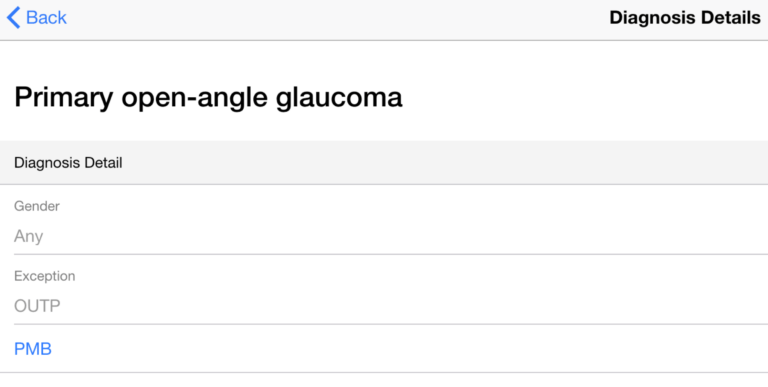
(Screenshot for Code H40.1 from Med ClaimAssist’s claims engine)
This shows that the code is for Primary open-angle glaucoma.
The most important thing that the screenshot shows is that the diagnosis is a PMB. This means that the Medical Scheme must pay the claim in full, whether or not the applicable benefit has been depleted.
This is an example of incorrect processing by the Scheme. One of the services offered by Med ClaimAssist is approaching the Scheme administrators on behalf of the patient, and with all the backing facts and information, to get the claim correctly processed and paid.
We look out for you!
+27 21 007 4516
Trading hours
08:00 - 16:30 Monday - Friday
info@medclaimassist.co.za
Claremont,
Cape Town, 7708